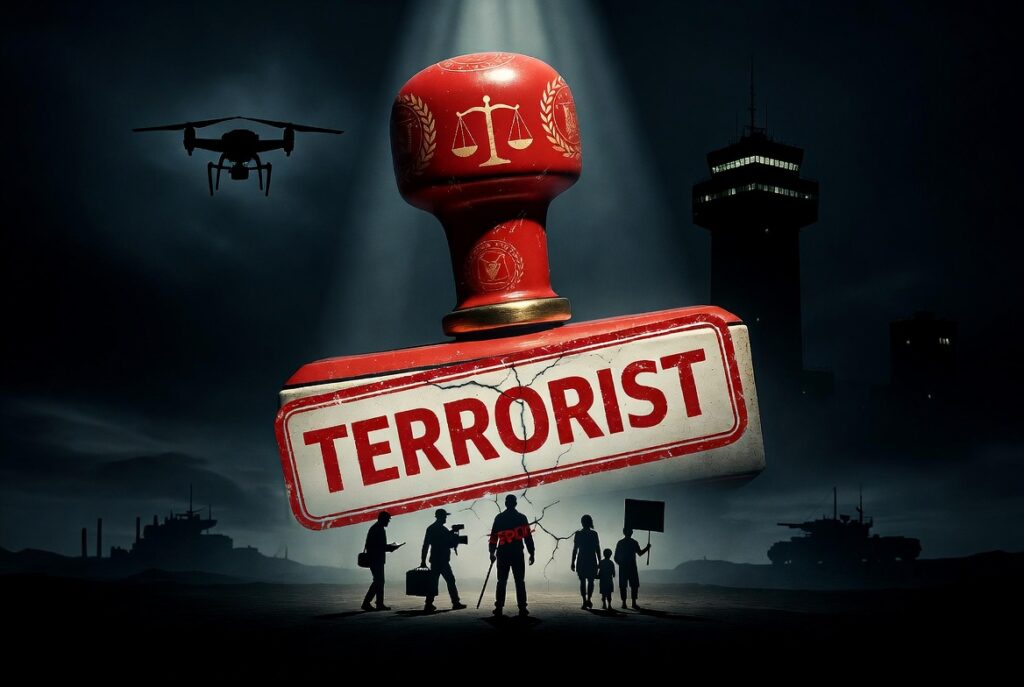
Enabling abuse through the mislabeling of terrorism isn’t an abstract risk. It’s already built into how states, institutions, and even the UN system talk about, regulate, and punish “terrorism,” often at the expense of civil society and ordinary people.
Why I chose this fight
I chose the title “Enabling Abuse Through the Mislabeling of Terrorism,” because I believe it fits what I’m trying to name: the way governments and institutions stretch, bend, or weaponize the word “terrorist” to justify harm that would be harder to defend in plain language.
For more than two decades, states have steadily expanded counter‑terrorism laws and powers. Human rights protections and democratic safeguards have not kept pace. UN experts now say bluntly that abuse of counter‑terrorism laws has become a “tool of choice” to suppress critics and civil society.
This essay is about that gap: how the label “terrorism” has become a permission structure for abuse, who controls that label, and what happens to people caught on the wrong side of it.
What mislabeling looks like in practice
When I talk about mislabeling, I don’t mean that terrorism isn’t real. Some groups absolutely do meet a clear, commonsense definition: deliberate attacks on civilians for political ends. The problem is how far beyond that core idea governments have pushed the label, and how often they use it to reach for more power rather than more safety.
There are a few recurring patterns.
Turning dissent into “terrorism”
Many governments now treat political opposition, protest, and watchdog work as potential terrorism problems rather than as normal democratic activity. UN Special Rapporteurs have documented how counter‑terrorism and “preventing violent extremism” measures are used against journalists, human rights defenders, students, and community organizers across all regions.
Instead of dealing with criticism, some states reach for broad “extremism” or “terrorism” laws to:
- Detain people on vague security grounds.
- Criminalize ordinary organizing and speech.
- Shut down NGOs through registration rules, banking restrictions, and sanctions.
A 2023 Global Study for the UN found a “playbook” of abuses against civil society in the name of counter‑terrorism: listings, judicial harassment, administrative orders, travel bans, and restrictions on financing. None of this requires a bomb or a plot. It only requires a broad enough law and a government willing to stretch it.
Scapegoating minorities
The “terrorism” label falls unevenly. It is thrown faster and harder at certain religious, ethnic, or political minorities. The UN’s global study notes that misuse of counter‑terrorism measures often targets religious, ethnic, and cultural minorities, women and girls, LGBT and gender‑diverse people, Indigenous communities, and other historically marginalized groups.
When an entire community is cast as a security threat, regular life becomes suspicious by default. Worship, language, clothing, or simple association can be painted as “extremist” or “supporting terrorism,” and harassment or mass surveillance starts to look normal to outsiders.
Criminalizing humanitarian work
There is another quiet casualty of mislabeling: people who try to keep civilians alive in conflict zones. Counter‑terrorism laws often include sweeping “material support to terrorism” provisions that don’t carefully distinguish between helping an armed group and delivering impartial aid in territory they control.
UN and civil‑society reporting shows humanitarian organizations facing blocked bank transfers, closure of programs, and even criminal risk for ordinary engagement needed to reach civilians—because the groups controlling an area are listed as terrorists. The law becomes a blunt instrument: if you’re near the wrong actor, you risk being treated as if you’re on their side.
Overbroad and vague laws
All of this is easier when “terrorism” is defined in fuzzy language. Many states criminalize not just violent acts but the “glorification,” “apology,” or “promotion” of terrorism, with no clear line between incitement and opinion.
The UN Office on Drugs and Crime openly notes that there is still no universally agreed definition of terrorism in international law, and that this open space allows politicization and misuse. At the same time, many treaties and national laws carve state armed forces out of terrorism definitions when they act under the laws of war, which makes it far easier to brand non‑state violence as “terrorism” while processing state violence through other labels like “military operation,” “excessive force,” or “collateral damage.”
That asymmetry—the ease of calling others terrorists, and the difficulty of calling states terrorists—is the hinge of the whole system.
The label as a permission structure
The label “terrorism” doesn’t just describe violence. It categorizes it. Once an act or group is placed in that category, a lot of legal and political machinery unlocks at once.
Normalizing exceptional force
In normal armed conflict, states are supposed to follow the UN Charter, the Geneva Conventions, and other rules about proportionality, distinction, and treatment of prisoners. When an adversary is cast as “terrorist,” governments often talk as if those rules don’t quite apply—or at least don’t matter as much.
UN experts have warned that a growing body of counter‑terrorism measures is associated with unlawful killings, arbitrary detention, torture, unfair trials, mass surveillance, and criminalization of peaceful expression and association. A 2023 UN‑mandated global study describes counter‑terrorism and “preventing violent extremism” as realms of “exceptionality,” where due‑process norms are weakened and human‑rights deficits “pervade.”
Once something is labeled terrorism, exceptional tools become thinkable: targeted killings, indefinite detention, extraordinary rendition, “black sites,” emergency laws that never quite expire. Publics that would balk at such measures against “criminals” or “rebels” are often more accepting when reminded, “These are terrorists.”
Lowering the bar for preemption
The label also shifts how risk is perceived. A “terrorist threat” sounds existential even when the actual capacity of the group is limited. That framing makes preemptive strikes, cross‑border raids, or long‑distance drone campaigns easier to sell as necessary self‑defense rather than optional war.
The 2001 “war on terror” frame helped justify not only the invasion of Afghanistan but years of operations across many countries under a single, open‑ended mandate. UN and UN‑linked analyses now treat that experience as a case study in how a terrorism frame can expand the geographic and temporal scope of conflict far beyond any clear battlefield or endpoint.
Expanding surveillance and policing powers
Domestically, terrorism designations often flip a switch in law. Many countries have statutes that expand surveillance, preventive detention, and policing authorities once terrorism is invoked. UN human‑rights bodies have documented widespread misuse of such powers, including arbitrary detention, intrusive surveillance, and the criminalization of legitimate political activity.
The Special Rapporteur on counter‑terrorism has warned about the spread of “administrative” measures—like restrictive orders, asset freezes, and security detention—that carry heavy consequences but skip the standards of ordinary criminal law. These tools are widely used to target people and organizations as “terrorists” without the evidence and safeguards that a criminal conviction would require.
Once again, the label is the key. When officials say “terrorist,” they aren’t just describing a crime; they are opening a legal side door.
Closing off diplomacy and off‑ramps
On paper, most governments say there is no negotiating with terrorists. In practice, conflict resolution often demands negotiation with whoever actually holds power on the ground, including armed groups with ugly records.
The problem is that once a group is legally listed as “terrorist,” even basic contact can become politically toxic or legally risky. UN and ICRC statements stress that humanitarian actors need to talk with all parties to a conflict to reach civilians and encourage respect for humanitarian law, yet counter‑terrorism rules often make such engagement hard or dangerous.
Research summarized in UN reports shows that proscription of armed groups as terrorists can obstruct peace processes by:
- Deterring mediators and third parties.
- Criminalizing travel and meetings.
- Making domestic publics hostile to any compromise.
The label narrows the space for diplomacy, sometimes long after the guns should have gone quiet.
How the label shapes conflict dynamics
The label doesn’t sit still. It changes how violence is seen, explained, and remembered.
Asymmetric delegitimization
Empirical work shows that calling the same actor “terrorist” rather than “insurgent” or “guerrilla” makes audiences more supportive of harsh measures and more likely to see the actor as illegitimate. At the same time, studies and UN reporting highlight that terrorism language is used far more often for non‑state and especially Muslim, Arab, Asian, and African actors than for Western or white supremacist violence with similar methods and civilian impact.
That asymmetry runs through news coverage, official statements, and legal frameworks. It creates a hierarchy of whose victims “count” and whose do not, and it influences which kinds of violence are treated as aberrations versus patterns.
Othering and dehumanization
“Terrorist” is not a neutral technical word. It comes loaded with moral judgment and fear. Scholars and UN experts describe it as a tool of “othering” that moves targeted groups outside the circle of normal politics and even outside the circle of moral concern.
Once someone is locked into that mental category, many people stop asking basic questions: Who are they? What grievances exist? What might reduce the violence? Instead, the conflict is retold as a morality play between civilization and barbarism. That may feel clarifying in the short run. It is disastrous over time.
Freezing grievances and feeding recruitment
When a movement is boxed as “terrorist,” its underlying grievances—occupation, discrimination, state repression—often fall out of polite policy talk. Governments and some media outlets treat attempts to discuss root causes as apology or justification.
From the perspective of people on the receiving end of indiscriminate raids, mass arrests, or bombing campaigns, this can feel like total erasure. Armed groups then use that sense of injustice and invisibility as recruitment fuel, pointing to state abuses done under the terrorism banner to argue that only force will be heard.
The label, in other words, can help generate the very adversary it was meant to contain.
Who actually controls the label?
There is no single world authority that decides what counts as terrorism. The UN has nineteen treaties dealing with specific terrorist acts and a few broad resolutions, but states have never agreed on a single, binding definition that covers all contexts. That gap isn’t just a legal curiosity; it’s the space where power operates.
Hegemonic states and formal lists
In formal law, the power to label sits mostly with states and the institutions they dominate.
- The United States Secretary of State designates Foreign Terrorist Organizations under national law, triggering sweeping “material support” crimes, asset freezes, and immigration bars, and these designations influence banks and allies worldwide.
- The European Union maintains its own terrorist list under its common foreign and security policy, enabling asset freezes and economic restrictions.
- The UN Security Council runs sanctions regimes (like the ISIL/Al‑Qaida list) that require all member states to impose travel bans, asset freezes, and arms embargoes on listed individuals and entities.
Permanent members of the Security Council hold veto power, so politics shapes who gets listed and who does not. Allies of major powers are often shielded; adversaries are scrutinized and named.
Other states—Russia, China, India, and many more—maintain their own terrorism lists, often blending genuine security concerns with moves against separatists, dissidents, or religious communities they view as threats.
Courts and “administrative” measures
Courts matter too, but often as the last step. When a judge upholds a terrorism designation or convicts someone under terrorism laws, a political label becomes binding legal reality. That unlocks security powers that would be off‑limits under ordinary criminal statutes.
At the same time, the UN’s counter‑terrorism rapporteur has warned of the rise of administrative measures—designation, security detention, control orders—that impose severe constraints without the evidentiary standards and safeguards of a criminal trial. These measures are easier to use, harder to challenge, and ripe for misuse against civil society.
Media, platforms, and narrative power
Formal control is only half the story. The label has to stick in public discourse to do its work. News organizations, social media platforms, think tanks, and officials all play a role in deciding which violence becomes “terrorism” and which is described in softer language. Newsrooms don’t just echo official language out of habit. Challenging an announced “terrorist” label in real time can carry professional, legal, and sometimes physical risk. Reporters work under breaking-news pressure, with limited verification, and often in systems where access, accreditation, surveillance, or even criminal exposure can punish those who question the state’s framing too early or too directly. In that setting, defaulting to official terminology is often the safer move, even when it leaves essential questions unasked. Once senior leaders call an act “terrorism,” agencies and outlets often align with that narrative, even if later facts complicate the picture.
Studies show that media are more likely to use “terrorism” when perpetrators fit certain profiles or when officials use the word early and confidently. Once senior leaders call an act “terrorism,” agencies and outlets often align with that narrative, even if later facts complicate the picture.
In the digital era, non‑state actors can fight back in real time. Armed groups, states in the Global South, and activist networks use online platforms to label powerful states’ actions as “state terrorism,” offering alternative frames that, even if they lack legal force, can shape global opinion.
The practical answer
Formally, many actors can utter the word “terrorism.” Practically, only some can make it a lived reality. Effective control of the label tracks with power: states that control financial flows, borders, weapons, and dominant media ecosystems.
A weaker actor can call a superpower a terrorist all day long. Unless courts, banks, and institutions act on that language, the consequences remain mostly moral and symbolic.
Where the UN stands—and falls short
The UN has tried to hold two truths at once: that terrorism is a real and serious threat, and that counter‑terrorism must respect human rights. It has produced declarations, treaties, and guidance on how to fight terrorism without abandoning the rule of law.
Yet UN‑mandated reviews now admit that the system itself has helped normalize abusive measures. The 2023 Global Study on the impact of counter‑terrorism on civil society concludes that misuse of these measures is “systemic,” not sporadic, and that a growing security architecture has steadily closed civic space.
The current Special Rapporteur, Ben Saul, has warned that administrative counter‑terrorism measures—especially designation, detention, and restrictive orders—are being misused across both democratic and authoritarian systems, often without adequate safeguards. His first report to the Human Rights Council paints a landscape full of unlawful killings, arbitrary detention, torture, unfair trials, mass surveillance, and criminalization of basic freedoms in the name of counter‑terrorism.
At the same time, UN human‑rights offices stress that when states invoke terrorism, they enter a “realm of exceptionality” where normal rules and protections tend to erode. That may help explain why the problem keeps growing despite years of warnings.
The human cost
It’s easy to talk about this topic in abstract terms—labels, legal frameworks, narratives. But what concerns me most is the steady widening of people who can be treated as fair game, with fewer questions asked.
When a government calls its critics terrorists, it lowers the bar for locking them up, tapping their phones, or shutting down their organizations. When a drone strike kills a family under a counter‑terrorism mandate, the chain of accountability is longer and murkier than in a regular criminal case or a conventional war.
The Global Study on civil society documents not just isolated stories but patterns: financial strangulation of NGOs, freezing of community leaders out of public life, constant legal harassment, and chilling effects that drive people out of advocacy work altogether. UN press statements warn that the misuse of counter‑terrorism measures can “jeopardise the freedoms of the innocent” and deepen grievances that fuel instability rather than resolve it.
The net effect is that “terrorism” has become a master label. Once applied, it tends to override other descriptors—teacher, medic, organizer, journalist, resident—and it tends to make harm more acceptable, as long as it is framed as necessary and preventive.
What would a more honest use of the label look like?
I don’t think the solution is to retire the word “terrorism” altogether. There is value in naming deliberate violence against civilians for coercive ends. But if we keep the label, we need to change the conditions under which it is used.
A more honest and less abusive system would at least do the following:
- Anchor definitions in observable tactics (deliberate targeting of civilians to intimidate or coerce), not in ideology, identity, or alignment.
- Apply the same criteria to state and non‑state actors alike in moral judgment, even if legal tools differ.
- Build independent oversight into listing and delisting decisions, with transparent criteria, evidence standards, and meaningful appeal.
- Protect humanitarian action and basic civic space in law, making clear carve‑outs for impartial aid and human‑rights work.
- Treat engagement with armed groups as a tool for protecting civilians and seeking peace, not as automatic complicity.
- Sunset emergency measures and demand regular review of counter‑terrorism laws for human‑rights compliance.
None of that will happen by accident. It will require steady pressure from civil society, some courage from courts, and a willingness inside states and the UN system to admit that the last twenty‑plus years of counter‑terrorism have damaged the very norms they claim to protect.
The sentence that should scare us
If I had to boil all of this down, it would be to a single dangerous sentence that keeps showing up in different forms:
“We don’t have to explain ourselves; they’re terrorists.”
Once that logic takes hold, law becomes paper, and the category of who can be harmed in silence grows. The label of “terrorism” will still be there; the question is whether we continue to let it do other people’s dehumanizing work for them.
Reading List
These readings deepen and document the patterns described above.
- UN Special Rapporteur on Counter‑Terrorism and Human Rights, Impact of Measures to Address Terrorism and Violent Extremism on Civic Space and the Rights of Civil Society Actors and Human Rights Defenders (A/HRC/40/52).
- UN Special Rapporteur on Counter‑Terrorism and Human Rights, Global Study on the Impact of Counter‑Terrorism on Civil Society and Civic Space (Global Study, 2023).
- Office of the UN High Commissioner for Human Rights, Rampant Abuse of Counter‑Terrorism Laws Threaten Human Rights Globally, Warns UN Expert (Press release, 11 March 2024).
- Ben Saul (UN Special Rapporteur), statement and report on Administrative Measures to Counter Terrorism and their human‑rights risks (2025).
- UN Office on Drugs and Crime (UNODC), Counter‑Terrorism Module 4: Defining Terrorism (Education for Justice initiative).
- OHCHR, Human Rights, Terrorism and Counter‑Terrorism (Fact Sheet No. 32).
- UN, Countering Terrorism (overview of UN counter‑terrorism architecture and challenges).