
The Promise We Haven’t Kept
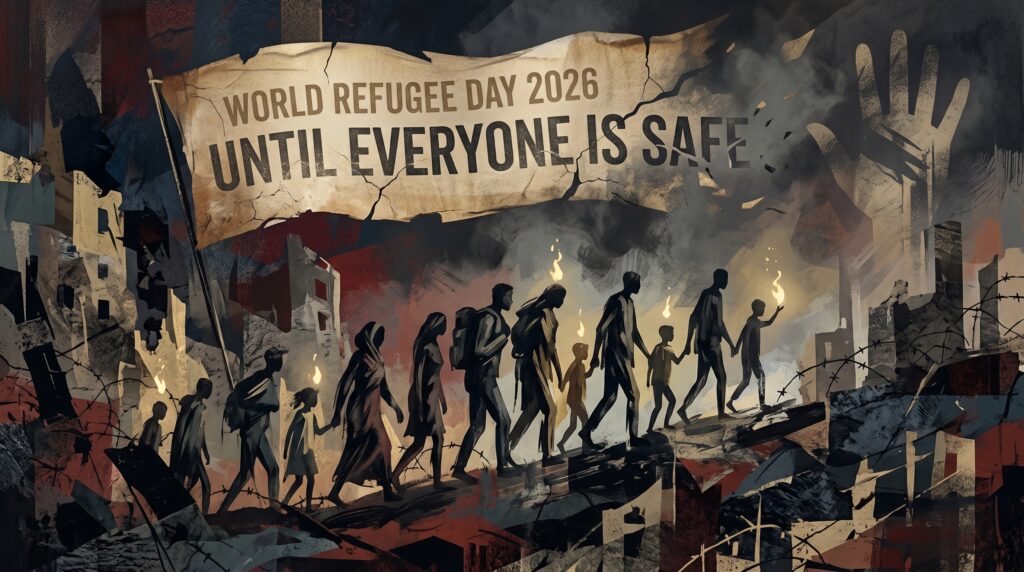
World Refugee Day comes around every year on June 20. We treat it as a time to honor the courage and endurance of people forced from their homes by war, persecution, and collapse.
But if we are honest with ourselves, it is also a day of indictment.
The global theme for 2026 is “Until Everyone Is Safe.” It sounds simple enough. Almost harmless. But it carries a hard truth. Safety isn’t safety if it belongs only to the lucky. Protection isn’t protection if it depends on geography, wealth, politics, or whether your suffering happens to arrive at the right border at the right time.
This year marks the 75th anniversary of the 1951 Refugee Convention. It was one of the big legal promises we made after the horrors of the twentieth century. The basic idea wasn’t complicated: people fleeing persecution shouldn’t be pushed back into danger. Human beings shouldn’t be returned to the fire just because they showed up inconveniently at someone else’s door.
That promise remains one of the more decent things the modern world has done.
It also remains deeply unfinished.
As of today, roughly 117 to 118 million people are forcibly displaced worldwide [1]. That number includes refugees who have crossed borders, asylum-seekers, and people uprooted inside their own countries. Put plainly, about one in every seventy people on Earth has been forced from home.
We have seen a slight improvement from the peak of recent years. Global displacement has stabilized or dropped modestly from the 2024 high of roughly 123 million people. In 2025, about 14.7 million displaced people went home, including roughly 4.4 million refugees [1].
That matters. Every return represents the chance to rebuild a life.
But we shouldn’t mistake movement for resolution.
Many returns happen under insecure, damaged, or desperate conditions. People might go home because the place they fled to has become impossible, not because the place they fled from has become safe. Going back can mean hope. It can also mean exhaustion. It can mean there is simply no good option left.
So yes, the numbers have eased slightly. But the crisis is still historically vast.
The Crisis Behind the Number
Large numbers have a way of numbing us. One hundred seventeen million people is too big to feel. It becomes an abstraction, like a humanitarian weather report. Just another global problem filed somewhere between climate change and political dysfunction.
But displacement isn’t an abstraction to the displaced.
It is a mother deciding what she can carry and what she must leave behind. It is a child learning a new language before understanding why home disappeared. It is an older person crossing a border with nothing but documents, medicine, and memory. It is a family living for years in the temporary, until the temporary becomes childhood, adulthood, and old age.
The refugee crisis isn’t one crisis. It is a convergence of many.
Sudan remains one of the clearest and most terrible examples, with millions uprooted by civil war and hunger [2]. Ukraine is another major source of displacement. Syria, Afghanistan, South Sudan, Myanmar, the Democratic Republic of Congo, Yemen, Colombia, Venezuela, and the occupied Palestinian territories all remain central to the picture. Some of these crises are new. Others have lasted so long we’ve grown used to them.
That might be the most dangerous thing of all. A crisis can become normal long before it is solved.
The Burden Isn’t Shared Equally
One of the most persistent myths about refugees is that wealthy countries bear the greatest burden. Politically, that myth is useful. Factually, it is wrong.
Most refugees are hosted by low- and middle-income countries [1]. Roughly two-thirds or more of the world’s refugees live in countries that already face serious economic and infrastructure pressures of their own.
That reality should change how we talk about responsibility.
The countries closest to conflict do the most immediate work. They absorb the first shock. They provide shelter when they can, space when they have it, and tolerance when their own systems are strained. Meanwhile, richer countries often argue about much smaller numbers as if they were carrying the whole weight of history alone.
This doesn’t mean border systems don’t matter. They do. States have real responsibilities to manage entry and security.
But the refugee question can’t be reduced to border management. It is a question of burden-sharing, legal obligation, and moral seriousness. The issue isn’t whether states can have rules. Of course they can. The issue is whether the rules keep the human being at the center of the system.
The 1951 Refugee Convention wasn’t built on sentimentality. It was built from memory. It came from a world that had seen what happens when persecuted people are treated as administrative nuisances instead of human beings in danger.
That memory is fading. Or worse, we are selectively ignoring it.
Protection Is a Promise, Not a Mood
The theme “Until Everyone Is Safe” is useful because it refuses to let protection become a slogan. It insists that safety must be measured by the condition of the vulnerable, not the comfort of the protected.
That is a high standard. We are nowhere near meeting it.
More than 2.5 million refugees need immediate resettlement, yet only a small fraction have access to regular pathways. In practical terms, that means many people who can’t safely go home also can’t legally move forward. They are stuck between danger and rejection.
This is where the system reveals its deepest failures.
We say people have rights, then we give them nowhere to exercise those rights. We say people shouldn’t take dangerous journeys, then we close the safer routes. We say smugglers are criminals, then we create the conditions where smugglers become the only available transportation.
That isn’t a functioning protection system. That is a bottleneck with moral language attached.
Asylum systems are under pressure. Some of that pressure is real, some is politically exaggerated. But the result is often the same: slower processing, harsher rules, and a public debate that turns desperate people into symbols of disorder.
The refugee becomes a stand-in for everything a society fears: insecurity, scarcity, cultural change, loss of control.
But refugees aren’t metaphors. They are people who had homes before they became someone else’s political problem.
Climate Is Making It Harder
Conflict and persecution are still the main drivers of displacement, but climate hazards now complicate nearly everything.
Three out of every four displaced people live in areas highly exposed to climate shocks. That doesn’t mean every refugee is a “climate refugee” in the legal sense. But it does mean floods, droughts, heat, and crop failure increasingly shape whether people can return, rebuild, or survive where they are.
Climate doesn’t always create displacement by itself. Often, it acts like an accelerant. It worsens weak governance. It deepens poverty. It turns temporary displacement into long-term displacement.
A family might flee violence, only to find their new camp is exposed to drought. A community might return after a conflict, only to discover farming is no longer reliable.
This is the future arriving unevenly.
The refugee system was built for a world of persecution and borders. It now has to operate in a world of conflict, climate stress, and food insecurity. The old categories still matter, but they are no longer enough.
The Meaning of Return
The increase in returns during 2025 deserves attention. Millions of people going home is a big deal. It suggests that in some places, conditions have shifted enough for people to try. It also shows the deep human pull of home.
People don’t leave home casually. And they don’t stop wanting home just because time has passed.
But return shouldn’t be romanticized. The question isn’t just whether people go back. The question is what they are going back to.
Is there shelter? Food? Schools? Hospitals? Are there landmines? Are armed groups still active? Can families reclaim property? Can anyone earn a living?
A return without safety isn’t a solution. It is just a relocation of suffering.
This is why World Refugee Day shouldn’t be reduced to either despair or celebration. There are real signs of movement, and real reasons for caution. The truth sits in the tension between them.
Some people are going home. Millions more cannot.
What World Refugee Day Asks of Us
World Refugee Day is often framed around support: advocate, donate, educate, amplify campaigns. All of that matters. Emergency relief matters. Shelter matters. Health care, education, and legal support matter.
But the day asks for something deeper than charity.
It asks whether we still believe protection is universal.
That is the test.
Not universal in speeches. Not universal when convenient. Not universal when the displaced are familiar, nearby, or easy to absorb. Universal means the right to protection doesn’t disappear when the person in need is poor, foreign, Muslim, African, stateless, or arriving in large numbers.
A refugee system that protects only the preferred refugee isn’t a refugee system. It is a preference system.
The 1951 Convention was born from the knowledge that states often fail the vulnerable when fear takes over. It was an attempt to place a legal floor beneath human panic. It didn’t solve displacement or end persecution. But it said there are some things a civilized world must not do.
Don’t send people back to persecution.
Don’t erase their humanity at the border.
Don’t make survival illegal.
Seventy-five years later, that floor is cracking.
Until Everyone Is Safe
“Until Everyone Is Safe” can sound like an impossible goal. In one sense, it is. There will never be a world without danger, conflict, or cruelty. No convention or slogan can promise that.
But the phrase doesn’t require perfection. It requires direction.
It asks whether the world is moving toward protection or away from it. Whether wealthy states are sharing responsibility or outsourcing it. Whether asylum remains a right or becomes a maze. Whether refugee children are treated as future citizens of somewhere, or as temporary bodies in permanent limbo.
The global displacement crisis has slightly improved by some measures. That is worth acknowledging.
But the deeper reality remains severe: more than 117 million people are still displaced. Tens of millions remain trapped inside their own countries. Millions live as refugees. Millions more wait for decisions, documents, safety, or the chance to begin again.
World Refugee Day should honor their resilience.
But we should be careful with that word. Resilience is admirable, but it can also become a way for the comfortable to praise people for surviving conditions they should never have been forced to endure.
The displaced don’t need the world merely to admire their strength.
They need the world to stop making strength their only option.
Until everyone is safe, the promise remains unfinished.
Reading List
If you want to understand the reality of displacement beyond the headlines, here are a few books worth your time:
- The Refugees by Viet Thanh Nguyen – A powerful collection of stories exploring the lives of Vietnamese refugees and the complexities of memory, identity, and starting over in a new country.
- A Long Way Gone: Memoirs of a Boy Soldier by Ishmael Beah – A harrowing and essential firsthand account of child soldiers and the brutal realities of war that force so many to flee.
- Refugee Economies: Forced Displacement and Development by Alexander Betts, Louise Bloom, Josiah Kaplan, and Naohiko Omata – A look at the economic lives of refugees, challenging the assumption that displaced people are merely a burden on host nations.
- Weeping Under This Same Moon by Jana Laiz – A moving story based on real events about the connection between a Vietnamese refugee and an American teenager.
References
[1] UNHCR. “Global Trends.” 2026. https://www.unhcr.org/us/global-trends
[2] Concern Worldwide US. “The largest refugee crises in 2026, in context.” https://concernusa.org/news/largest-refugee-crises/