
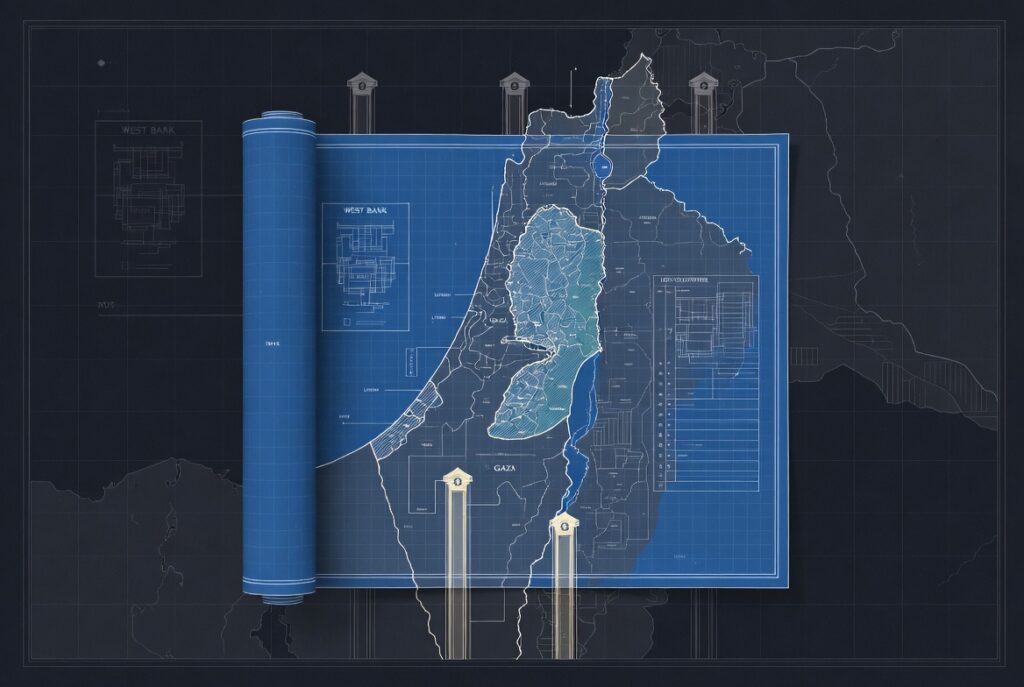
Introduction: The Shift from “If” to “How”
For decades, observing Middle Eastern politics required reading between the lines. Governments routinely utilized “strategic ambiguity”—the practice of letting actions speak while keeping official policy vague enough to maintain diplomatic deniability.
But throughout late 2025 and into 2026, Israel’s public-facing policy underwent a fundamental recalibration. The quiet strategies of the past have been replaced by open, unapologetic advocacy. This isn’t just a change in rhetoric; it is a structural rewiring of how the state approaches its borders, its legal system, and its domestic social contract.
To understand where the region is heading, we have to look past the high-intensity news cycle and examine the civic and bureaucratic levers currently being pulled.
Pillar 1: Moving the Bureaucratic Borders
The most profound changes often happen not on a battlefield, but in a committee room.
- The Old Mechanism: For decades, administrative power in the West Bank was held primarily by the military. This kept the territory under a legal framework of temporary occupation, leaving its ultimate status open to theoretical future negotiations.
- The 2026 Lever: In February 2026, Israel’s security cabinet approved the transfer of these administrative powers from the military to civilian government ministries. Simultaneously, they lifted long-standing restrictions on land purchases and accelerated settlement expansion.
- The Civic Meaning: By treating the territory as a civilian administrative zone rather than a military occupation, the government effectively normalized a de facto annexation. It signals to the world that the state is shifting from temporary conflict management to permanent territorial integration.
Pillar 2: The Strain on the Social Contract
An aggressive outward security posture requires immense internal stability, but Israel’s domestic civic foundations are facing unprecedented pressure.
- The Old Mechanism: Since the founding of the state, ultra-Orthodox men have enjoyed systemic exemptions from military service, a compromise designed to protect religious study.
- The 2026 Lever: The Supreme Court ruled that these military service exemptions must end, sparking violent domestic protests and a deep political crisis for a government that relies heavily on ultra-Orthodox political backing.
- The Civic Meaning: This is no longer just a cultural debate; it is a full-blown crisis in the rule of law. As defense spending consumes nearly 9% of GDP and prolonged reservist call-ups pull everyday citizens out of the workforce, the inequality of the draft is fracturing the foundational social contract that holds the domestic population together.
Pillar 3: United States Enablement
A nation’s foreign policy is often constrained by the threat of global pushback. For Israel, that traditional constraint has effectively vanished.
- The Old Mechanism: Historically, while the United States has been a staunch ally, it traditionally balanced its support with diplomatic caveats—urging restraint or lightly pressing Israel to halt settlement expansion to keep the possibility of a two-state solution alive.
- The 2026 Lever: Despite widespread global condemnation from human rights groups and Arab nations, the U.S. has provided uninterrupted military aid and used its U.N. Security Council veto to shield Israel from international accountability. Prominent American political figures have even shifted from defending Israel’s right to exist to publicly endorsing its territorial expansion.
- The Civic Meaning: In diplomacy, the absence of consequences acts as an accelerant. Without economic sanctions or diplomatic friction from its primary ally, Israel has concluded it can pursue bold, expansionist goals without paying a global price. This active insulation has removed the guardrails, empowering the government to act with profound confidence.
Pillar 4: The “1948 Mindset” and Redrawing the Map
The rhetoric surrounding military operations has shifted from temporary defense to permanent restructuring.
- The Old Mechanism: For years, Israel’s primary military doctrine focused on “conflict management”—maintaining the status quo, managing threats, and launching retaliatory strikes when provoked.
- The 2026 Lever: Following military campaigns in Gaza, an offensive into southern Lebanon, and direct strikes on Iran in 2025, Israeli officials have embraced a posture that commentators describe as a return to a ‘1948 mindset,’ articulated by figures like Benny Gantz. This doctrine favors proactive, preventive operations and the creation of physical buffer zones outside of Israel’s internationally recognized borders.
- The Civic Meaning: When Prime Minister Netanyahu demands that Hezbollah be pushed back behind the Litani River, and when other officials describe that river as Israel’s border, they are no longer talking about temporary military incursions. It reveals a strategic assessment that the current chaos in the Middle East has opened a rare historical window to permanently reshape the region’s borders by force.
Conclusion: The Closing Window of Opportunity
What we are witnessing in 2026 is not a random series of escalations but a highly coordinated pivot from managing a conflict to dismantling threats, establishing buffer zones, and creating nearly irreversible circumstances on Israel’s terms. By examining the civic and administrative levers—moving West Bank governance to civilian ministries, rewriting land-grab laws, and explicitly redrawing security maps—the government has made its long-term intentions clear. The era of strategic ambiguity is officially over.
However, this aggressive outward push is driven as much by a sense of urgency as it is by confidence. Israeli leadership is acutely aware that they are operating inside a temporary historical window. Domestically, the severe economic toll of prolonged mobilization and the fracturing of the social contract over military exemptions mean the current status quo cannot be sustained indefinitely. Internationally, while the current alignment in Washington provides near-total diplomatic and military cover, there is no guarantee that global political conditions will remain this permissive forever.
Ultimately, Israel’s policy recalibration is a race against time. The state is moving quickly to establish irreversible facts on the ground—bureaucratically, legally, and territorially—before internal fractures or shifting international dynamics can force the window shut. For the average observer, understanding this conflict no longer requires guessing at Israel’s ultimate goals. The blueprint has been moved from the fringes of political rhetoric straight into the mechanics of state policy.